The FM Toolkit. Never been done before.
How an online Football Manager draft becomes a save you can play: the formats, snake-draft maths, computer managers and the rule every file is held to.

If you play Football Manager with friends, there’s a good chance you’ve done a draft. Everyone gets a budget and a turn, and you build squads out of one shared pool of players. People run them in group chats, on spreadsheets and live on stream. They’re great fun right up to the last pick.
Then the draft ends, and you’ve got a list.
To actually play the season you’d just drafted, someone had to open the official editor and rebuild every squad by hand. Find the player, move him to his new club, then do it again for the next one, and check nothing got missed. For a big draft that’s an evening gone, and it was usually the same person doing it every time.
Nothing could do it for you, because nothing could write the game’s files. So I built the first tool that does.
I co-founded the FM Toolkit with two partners. I made the brand, the website and the converter. It’s the hardest thing I’ve built, and this is the long version: what it does, the numbers behind it, why it works the way it does, and what went wrong on the way. I’ve left out how. That part stays with us.
What a draft night looks like
Start with the player’s side, because that’s what everything else is for.
The host picks a format, sets the rules (squad size, budget, how long the pick clock runs, how turns are ordered) and sends the link round. People join the lobby, name their club and press Ready. Any seat nobody takes goes to a computer manager when the draft starts, so the field is always full.
Then the clock starts. When it’s your go, you can’t miss it. The top of the room shows the round, your clock, the pick before yours and who’s up after you, and the browser tab changes its title so you’ll see it from another window.
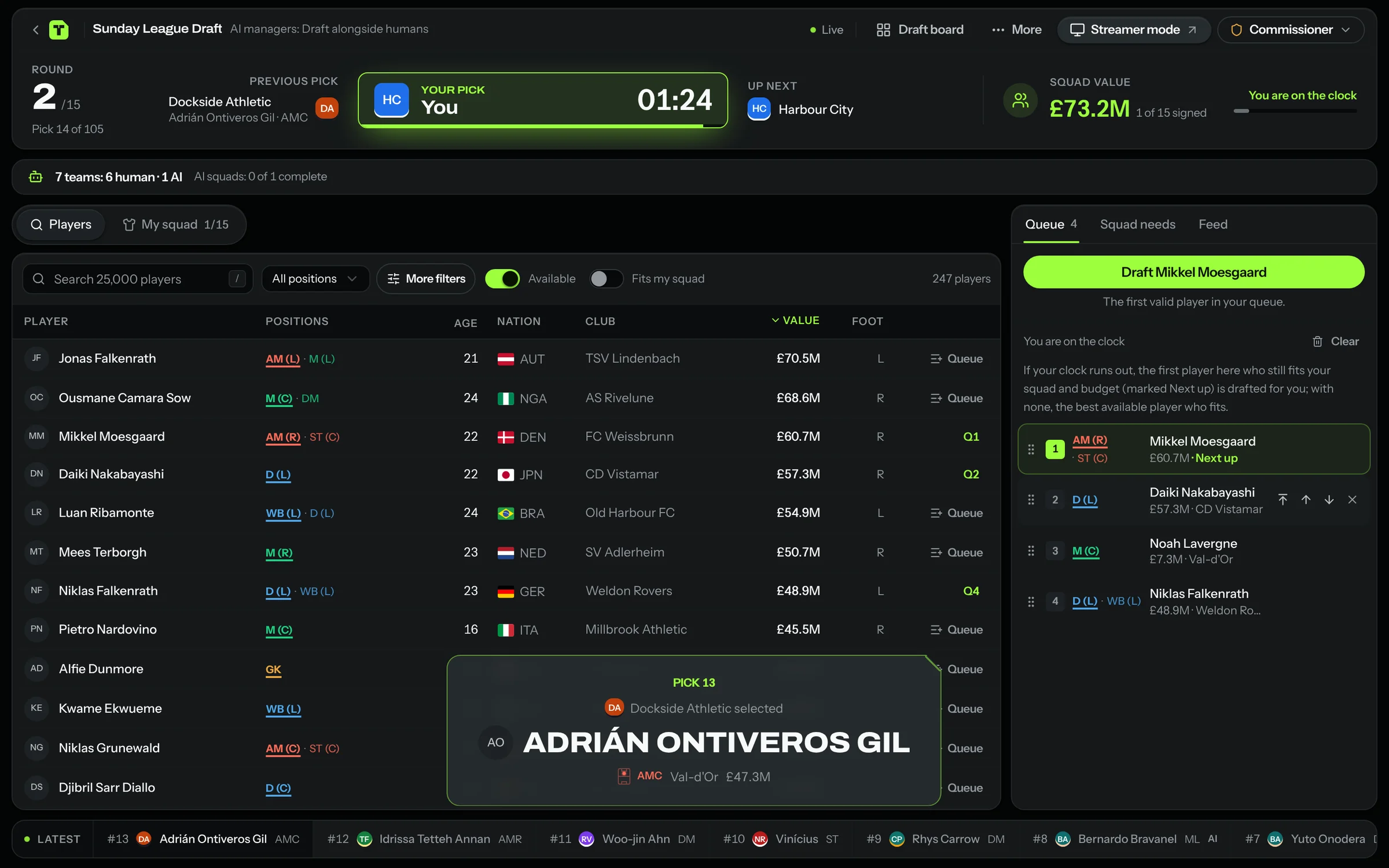
The player list holds every eligible player in the game. You can search by name, filter by position, league, nationality, foot, age and value, hide anyone already taken, or show only the players who’d still fit your squad and what’s left of your budget.
You don’t have to sit there waiting for your turn, either. Everyone has a private queue. Line up the players you want, and if your clock runs out, the room drafts the first one in your queue who still fits your squad and budget. If none of them do, you get the best available player who does. Nobody else can see your queue, and when someone else takes a player you’d queued, he drops out of it and the room tells you who took him.
The queue is there because people step away. They make a cup of tea, their laptop goes to sleep, the baby wakes up. A draft with twelve people in it can’t stop every time one of them does, and a missed turn shouldn’t wreck anyone’s squad.
On a phone
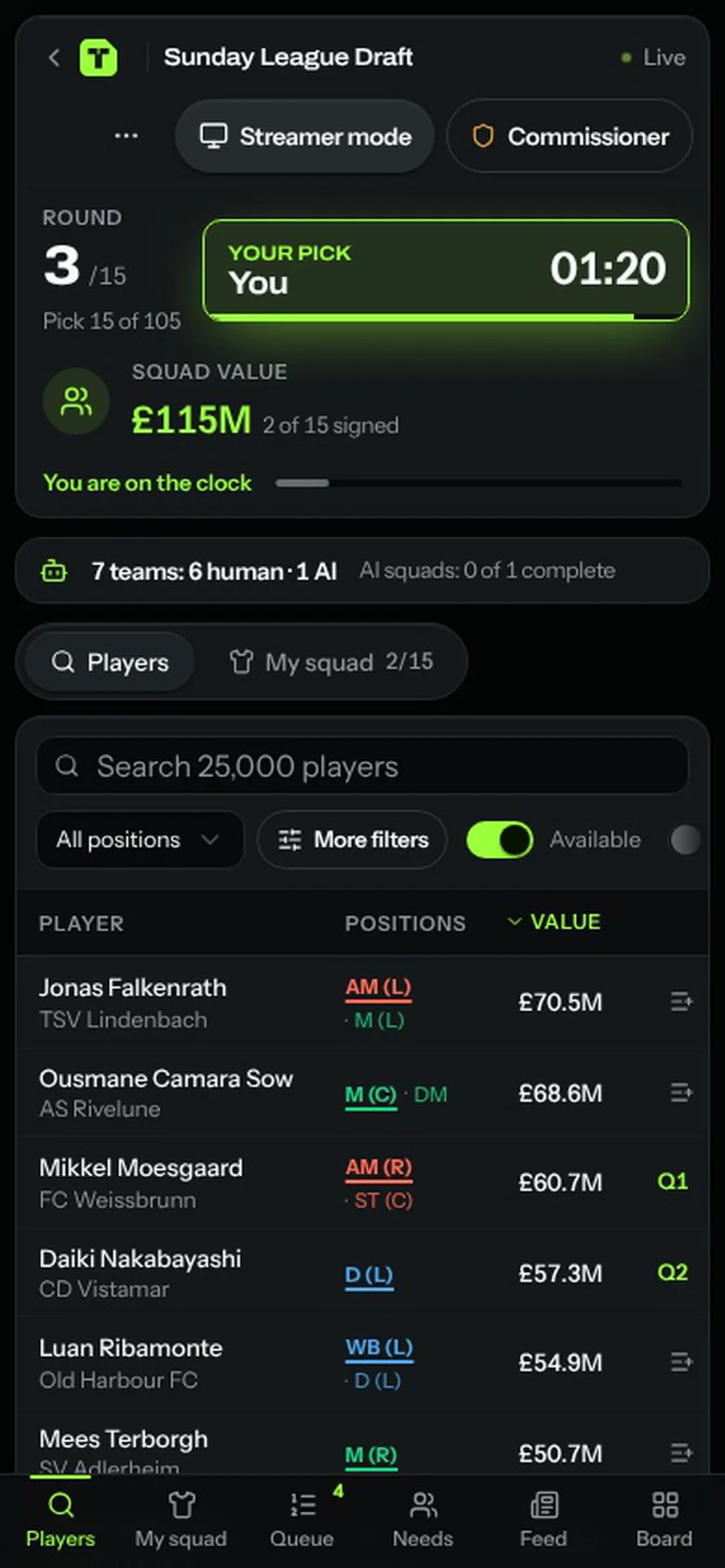
Plenty of people draft from the sofa, so the room works the same on a phone. The clock and your squad’s value stay at the top, and the queue, your squad, what your squad still needs, the feed and the board each get a tab along the bottom.
Fifteen formats, and the numbers behind them
A draft on the Toolkit isn’t only a list of squads. It’s a tournament you’re going to play in the game, so the host starts by choosing which one. There are fifteen, each a ready-made Football Manager competition: leagues, group stages, knockouts, and some shaped like competitions you’ll recognise.
Every format uses 23-player squads, so the number of picks is easy to work out: teams times 23.
| Teams | Format | Picks |
|---|---|---|
| 4 | League, each team plays the others four times | 92 |
| 8 | Two groups of four, then knockouts over two legs | 184 |
| 9 | Streamer Showdown | 207 |
| 10 | League, each team plays the others twice | 230 |
| 16 | Straight knockout, two legs a tie except the final | 368 |
| 20 | League, each team plays the others twice | 460 |
| 24 | Six groups of four, in the shape of the 1994 World Cup | 552 |
| 32 | Eight groups of four, in the shape of the 2022 World Cup | 736 |
| 32 | Eight groups of four over two group stages, in the shape of the 2000/01 Champions League | 736 |
| 36 | Six groups of six, then knockouts | 828 |
| 36 | A league phase of five games each, then knockouts | 828 |
| 36 | A league phase of nine games each, and the table decides it | 828 |
| 40 | Ten groups of four over three group stages | 920 |
| 48 | Twelve groups of four, in the shape of the 2026 World Cup | 1,104 |
| 50 | Ten groups of five, then knockouts | 1,150 |
A 50-team draft is 1,150 picks. If every manager used a full minute on every pick, it would run for over nineteen hours. Nobody does, but that sum is why the private queue, the computer managers and a sensible clock all matter. They’re what turn a weekend into an evening.
Every club in the format is a drafted team. Fill four seats with people in a 48-team World Cup and the other 44 are computer managers. There’s no half-empty tournament where some clubs play with squads nobody picked.
Six ways to take turns
How turns are ordered is a separate choice from the format, and it changes the draft more than you’d think. The host has six:
- Snake. The order reverses every round, so whoever picks last in one round picks first in the next.
- Linear. The same order every round.
- Third round reversal. A snake, except round three runs the same way as round two, and it snakes on from there.
- Random order. A fresh order every round, drawn once when the draft starts and kept.
- Custom. The host sets the order for every round.
- Fixed price. Snake turns with the budget on, so every player costs his market value.
Here’s what the first four rounds look like with four teams, A to D:
| Round | Snake | Linear | Third round reversal |
|---|---|---|---|
| 1 | A B C D | A B C D | A B C D |
| 2 | D C B A | A B C D | D C B A |
| 3 | A B C D | A B C D | D C B A |
| 4 | D C B A | A B C D | A B C D |
The maths of a snake
The snake exists to make the order fair, and it’s worth seeing how well it does.
In a snake with N teams, the team in seat s picks at number s in round one and at number 2N + 1 − s in round two. Add those together and you get 2N + 1, whatever the seat. So over any pair of rounds, every team’s picks add up to the same total. With four teams, A picks 1st and 8th, D picks 4th and 5th: both add up to 9.
The cost of the snake is the wait. Between your two picks at a turn, the gap is 2(N − s) picks one way and 2(s − 1) the other. The first and last seats get two picks in a row at one end of the round, then the longest wait in the draft at the other: 2(N − 1) picks. In a 50-team draft that’s 98 picks between turns, which is exactly what the private queue is for.
The snake’s weakness is that equal totals aren’t equal value. The first pick of the whole draft is usually worth far more than the eighth. Third round reversal is a fix borrowed from fantasy sports: by running round three backwards as well, the team that had the first pick of the draft picks last in round three, and the team that picked last in round one goes first. Linear has no such balancing at all. It suits a draft where the order was earned somewhere else, like a league that finished last season.
The board
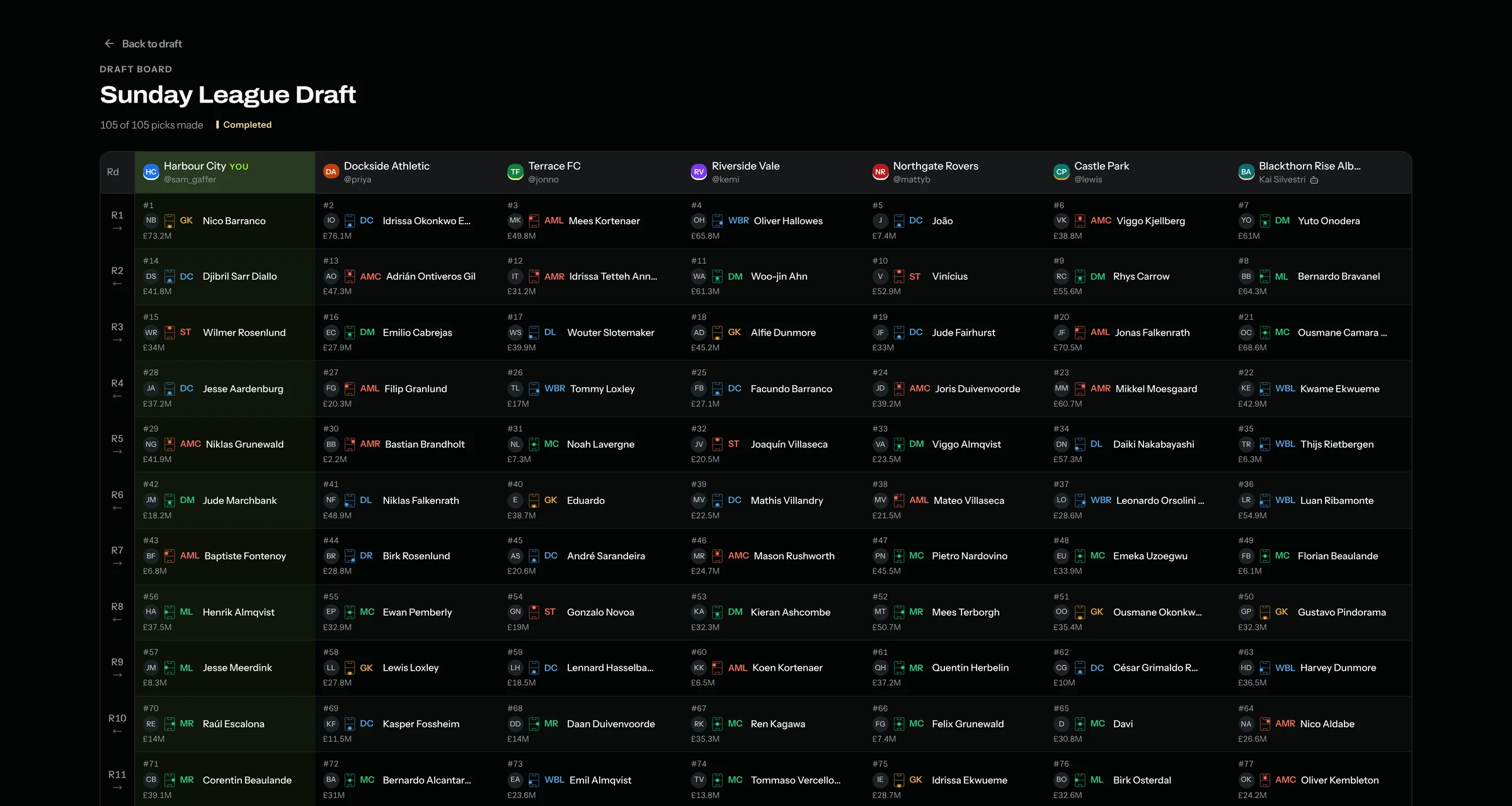
The draft board shows every pick on one grid, team by team and round by round. It’s where most of the arguments start, and it’s kept for good once the draft is over.
Computer managers
Every empty seat is filled by a computer manager, and I wanted them to be proper opponents, not filler.
Each one is a real manager from the game’s own database. The host can leave them to be drawn at random, choose them by name and put each one on a particular team, or draw them from a league or a nationality. When the save is made, each manager is put in charge of the club he drafted, so you’ll meet him on the touchline.
They draft like managers, too. Each one builds towards his preferred formation, so a manager who likes a back three drafts centre-backs, and one who plays with wingers goes looking for them. They pick from the same pool, under the same squad rules and budget, and their turns come round like everyone else’s.
They don’t use a chatbot and they don’t roll dice. Give the same draft the same picks and they’ll make the same choices, which matters when someone says the computer stitched them up. You can go back and see exactly why.
Two settings are the host’s:
- When they pick. Alongside the people, in their seats, or after all the people have finished. The second gives the people first go at the pool between themselves.
- How fast they pick. Instantly, or with a short countdown of up to 30 seconds (10 by default), so a room full of people can actually see each computer pick land.
Finding the right player
A Football Manager database is huge, and most people know a few hundred players well. So a lot of the room is about helping you find the rest.
Rank By Position
The game rates players with ability scores that it never shows you directly, and the room doesn’t show them either. You draft on what you can see: positions, attributes, age, club and value.
To help, the room has its own ranking. Rank By Position scores each player on the attributes that matter in his position, so a centre-back is judged as a centre-back and a winger as a winger. Each player is then ranked against everyone else in his own position, across the whole pool. It’s the Toolkit’s guide, not the game’s rating, and the room says so.
You can sort by it, or filter to, say, the top 50 left-backs.
Attributes, filters and comparison
You can sort and filter by any of the game’s attributes, set a range on several at once, and choose which attributes show as columns. Filter options show how many players each one would leave you with, so you can see a dead end before you walk into it.
One rule I held to here: a missing figure is never a zero. Some players simply don’t have every attribute recorded. A zero would push them to the bottom of a sort and leave them out of a filter, as if they were hopeless. Instead they go to the end in both directions, and a filter never treats them as a match. Showing nothing is better than showing something wrong.
When it comes down to two or three names, you can put up to four players side by side. The best figure in each row is marked, except where “best” makes no sense: age, value, wages and height are just facts. There’s no overall winner and no rating. The decision’s yours.
When the budget runs dry
Budget drafts have a nasty edge case. You plan to fill your last places with cheap players, and then other managers take the cheap players first. Now nobody left is affordable and you can’t complete your squad.
Most drafts would just stall. The Toolkit has a rescue: if, and only if, you’re on the clock with no legal pick, you can sell one of your players back to the pool for 75% of his value. The other 25% is gone for good, so it’s never worth doing on purpose. The sale has to leave you with someone you can afford to pick, or it isn’t allowed, and your next pick fills the gap straight away. Squads still finish full, and the draft keeps moving.
Running the room
The host gets commissioner controls: pause the draft, add time to a clock, force a pick, or undo the last one.
- Pause keeps whatever time was left on the clock, to the second, and gives it back on resume.
- Undo takes back the last pick, puts the player back in the pool and gives the manager a fresh clock. If the draft had finished, it reopens.
- Force a pick makes the pick the clock would have made, for someone who’s gone missing.
Forcing a pick and undoing one both need a second click to confirm, and every action goes into a log that nobody can change afterwards, me included. When there’s an argument at eleven at night about whether a pick should stand, the log settles it.
On stream
Plenty of drafts are run live on stream, so there’s a broadcast view made for streaming software. It shows who’s on the clock, how long they’ve got and who’s coming up, and reveals each pick to viewers as it lands.
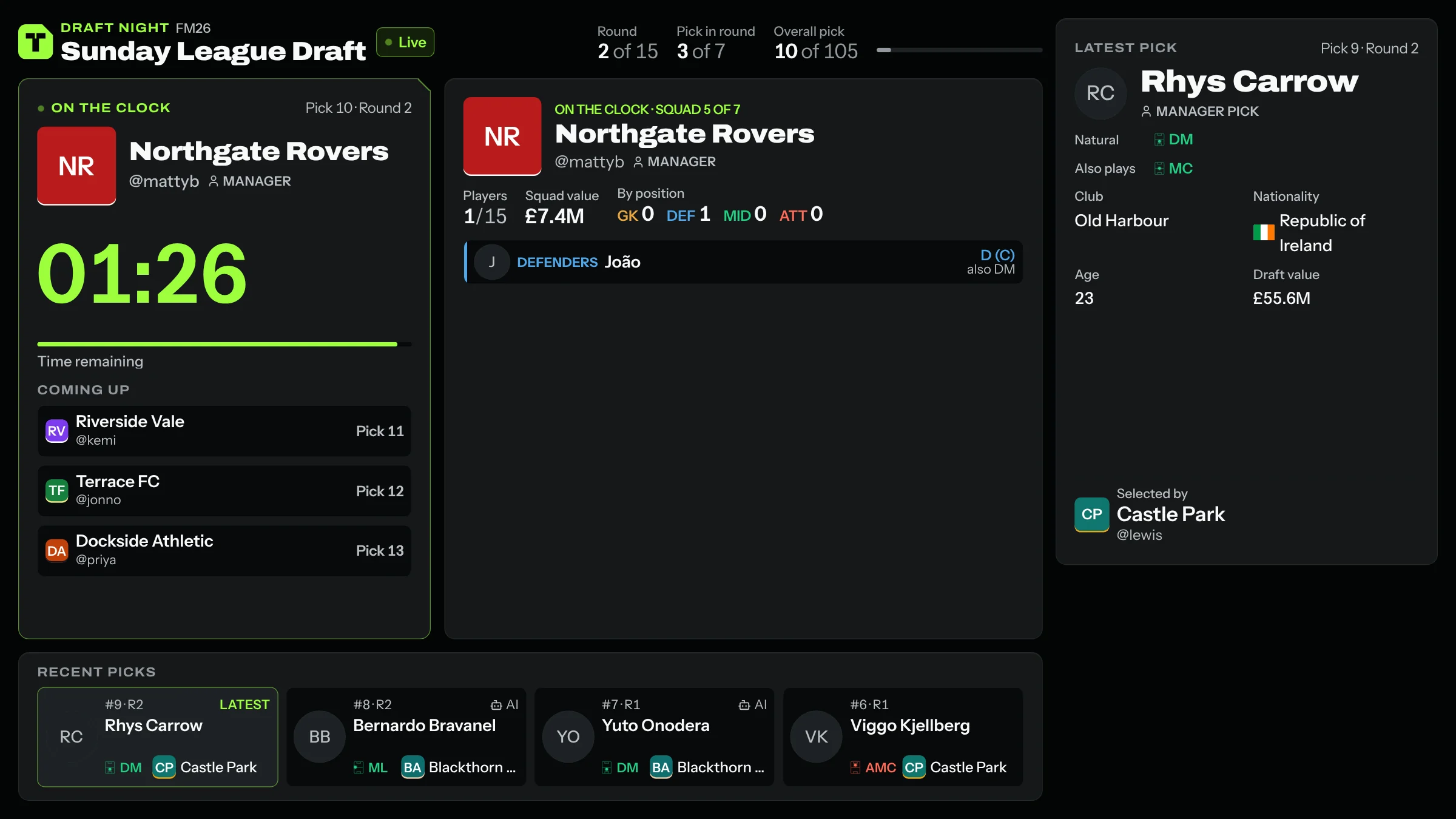
The streamer controls it from their own screen, and the broadcast follows: which team is on show, list or formation view, and whether to replay the last pick. It can carry the stream’s own logo, colours, background, title and a sponsor, and it keeps a 16:9 space clear in whichever corner the webcam sits, so nothing ever ends up behind a face. When the draft’s over, it plays a recap: the overview, each squad and the highlights.
When it’s over
Once the last pick is in, every squad gets its own page. The squad builder lays your team out on a pitch in whichever formation you choose, using the same positions the game’s own tactics screen uses.
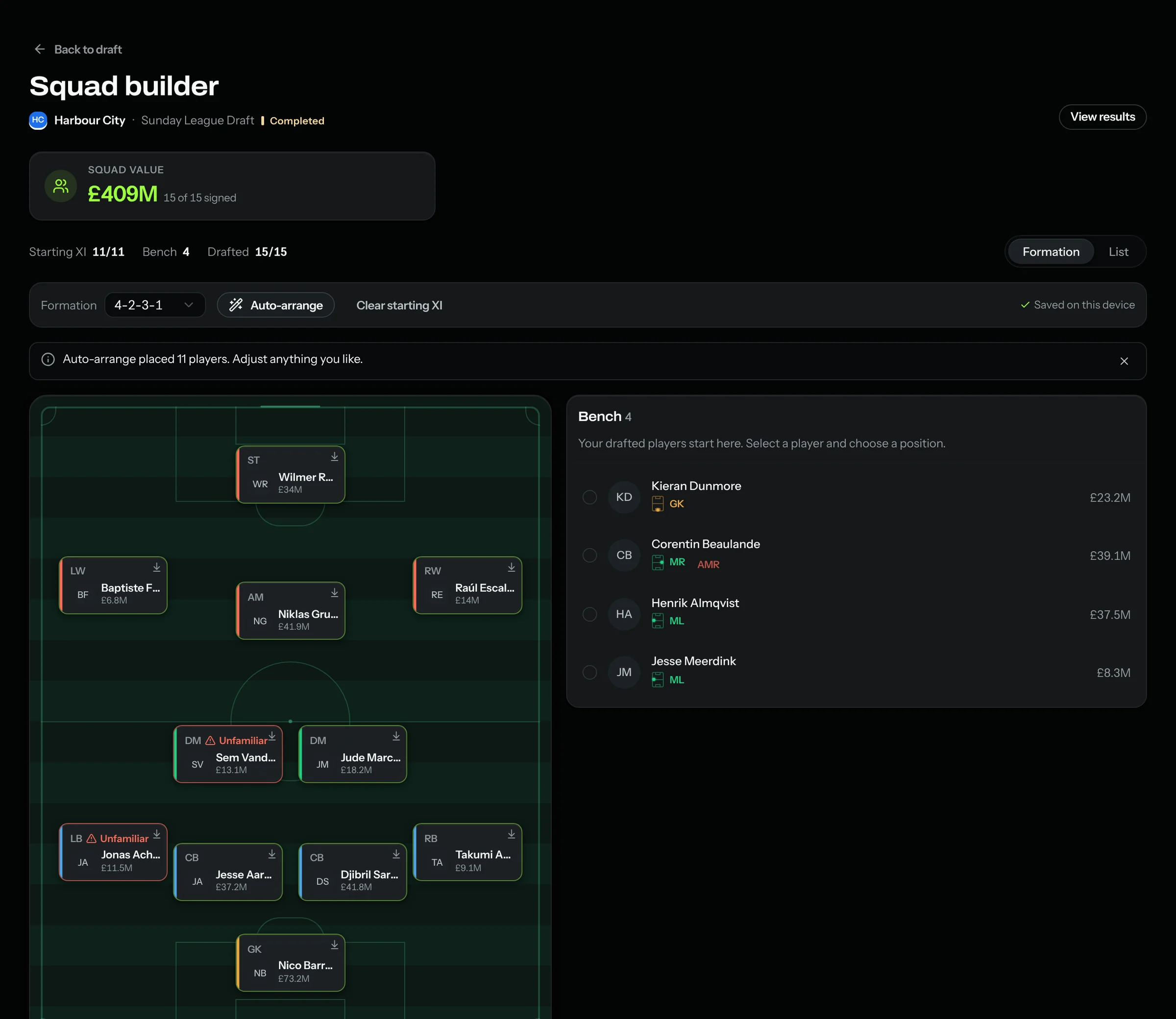
It never moves anyone without being asked. Everyone starts on the bench, and you drag players where you want them, on a mouse or a touch screen. Play someone out of position and it flags him. Ask it to arrange an eleven and it uses only positions each player can actually play, fills as many places as it can, and prefers players in their natural position. Goalkeepers stay in goal, and nobody else goes there.
The results page lets you compare squads, see the most valuable players taken, and look at each team’s lineup. Every figure on it is the player’s market value in the game’s database, so it’s labelled market value, never “price paid”.
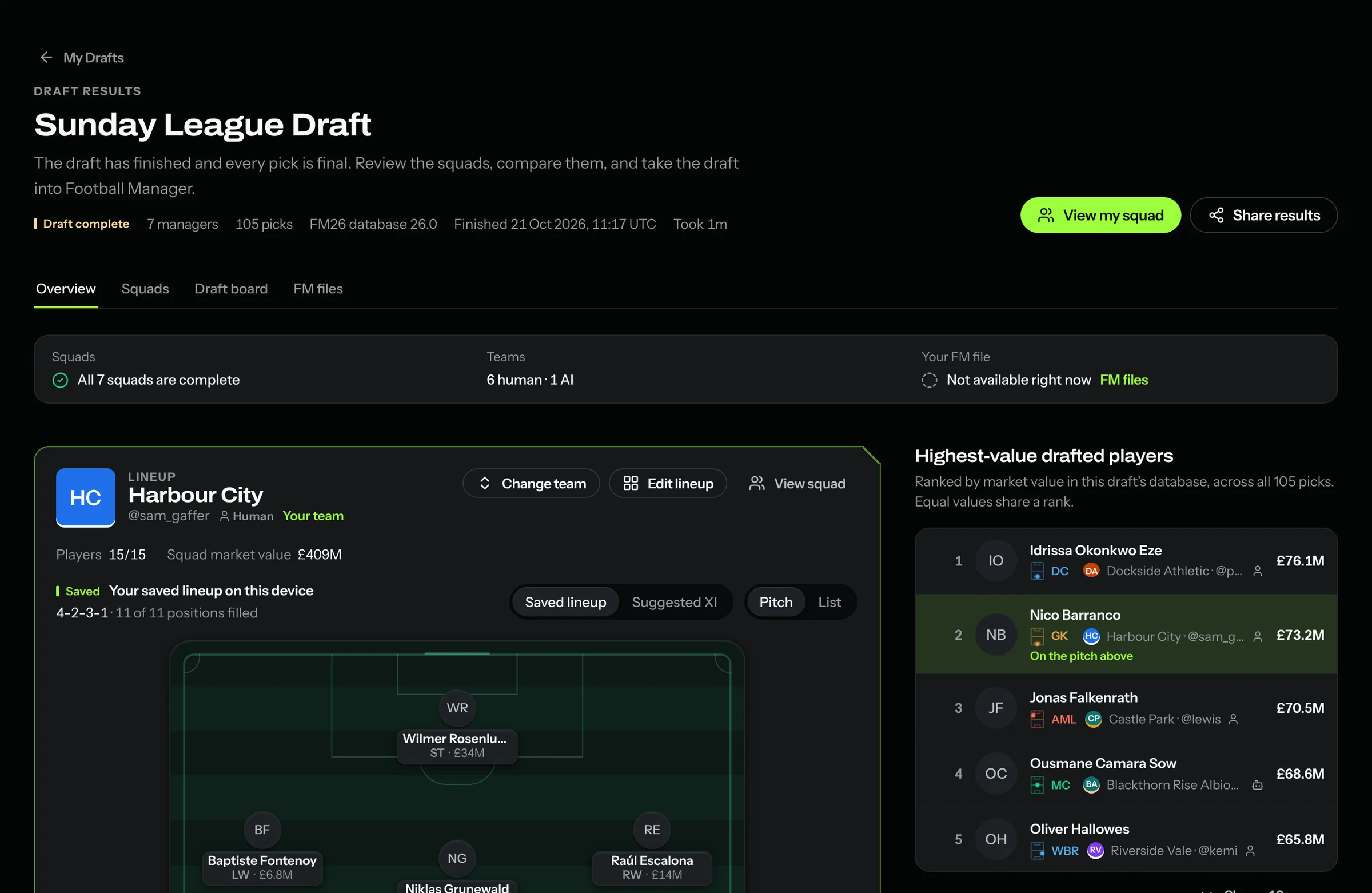
Then comes the part that didn’t exist before. The host downloads a Football Manager career save with the draft already in it, drops it into the game’s folder and loads it. That’s your season. It works with FM27, the latest edition of the game, though it isn’t available for every format yet.
The draft happens on the website. The matches are played in Football Manager, by you. The Toolkit never simulates a game, and it was never meant to.
What goes into the save
A list of picks becomes a whole tournament. Here’s what the save holds when you open it:
- Every drafted squad, each player at the club that drafted him, in the format you chose.
- Your club, as you named it. The name, short name, three-letter abbreviation, nickname, stadium name, colours, and home and away kits you set in the lobby go into the save with it. Real club names aren’t allowed: it’s your club, not Real Madrid with a new badge.
- The computer managers, each in charge of the club he drafted.
- Team one in the draft is club one in the save, team two is club two, and so on, the same way every time.
Two rules sit behind that list.
Every pick, or it says so. Before a file is handed over, every pick is checked against what actually went into it. If a player didn’t make it, the file isn’t called complete, and you’re told which player and why. It never quietly swaps in someone similar. A save that looks right but has the wrong left-back is worse than one that tells you it’s short.
You can only draft players the save can hold. A Football Manager save only contains the leagues it was made with, so a player from a league that isn’t loaded can’t be put in it. Rather than let you draft a player and then tell you he can’t come, a tournament draft’s pool only offers players its save can hold. You find out at the start, not at the end.
Byte for byte
The converter works with Football Manager’s own file formats, and it’s held to one rule: the file it writes has to match the file the official editor would have written, byte for byte. “It loads” isn’t good enough. Neither is “it looks right”.
That sounds fussy until you see how a save file goes wrong. A broken web page looks broken. A broken save file usually loads fine. Then, forty hours into a season, a cup draw goes strange, a player vanishes from a squad, or the game closes without a message. There’s no error to read and nothing to point at, and the draft that made the file was weeks ago.
So “the game opened it” can’t be the test. The editor is where the format comes from, which makes its output the reference. If my file differs from the editor’s by a single byte, mine is wrong, even if the game seems perfectly happy with it.
Where it stands:
- On every test file, the output matches the official editor’s, byte for byte.
- The editor opens the files, and the game has played a full season from one.
- Every file is read back and checked before anyone gets it. If something’s wrong, you see an error straight away, rather than a broken season months later.
- A normal draft converts in about 0.4 seconds.
- The biggest file I’ve put through it was 785 MB, carrying 2.1 million changes. It took 51 seconds and never used more than 225 MB of memory.
Reading those numbers
The last one is there to find the ceiling, so it’s worth putting next to a real draft. The biggest draft the site runs is fifty teams of 23 players: 1,150 picks. The stress test carried 2.1 million changes, about 1,800 times as many, at a little over 41,000 changes a second. I wanted to know where the edge was before anyone got near it, and the answer is a very long way off.
The 0.4 seconds matters for a different reason. It’s short enough that making the file is never the thing you wait for. On a draft night the slow part is always the people, which is how it should be.
What the rule costs
It costs a lot, and I’d rather be straight about where.
Features wait. Some things would be easy to fake: write something close enough, let the game smooth it over, and most people would never notice. None of that goes out. If a change can’t be written exactly the way the editor writes it, it isn’t offered yet.
Every new edition of the game has to be checked against its own editor before anyone can use it, so a release day means work before it means anything else.
And sometimes the answer to a request is “not yet”. I’m fine with that. People spend months in a save. If I hand someone a file, I want to be able to say it’s right, without a “probably”.
Keeping a live room fair
A live draft sounds simple. In practice it’s every awkward case at once: two people clicking at the same instant, a laptop that sleeps through its turn, a phone reconnecting on a train, a computer clock that’s four minutes fast. A dozen people are each watching their own screen, and every one of those screens has to agree.
One decision settles most of it: nobody’s browser gets to decide anything.
- One referee. Whose turn it is, whether a player’s still available, whether a pick fits the budget, when the draft’s over: all of it is decided in one place on the server, and only there. If two people pick at the same moment, one pick goes through and the other is told the turn has moved on. They can’t both win.
- Everyone sees the same draft. If your connection drops, the room doesn’t try to patch things up. It redraws itself from the draft as it stands, so a reconnect, a laptop waking up and a brand new tab all land exactly where everyone else is.
- The server keeps time. Every countdown follows the server’s clock, not your device’s. A fast clock buys nobody extra seconds, and a slow one doesn’t cost anyone a pick. That matters more than it sounds when managers are in different time zones.
- No one-key picks. There are keyboard shortcuts for almost everything in the room, but a pick always needs you to confirm it. A stray key press should never cost anyone a player.
- Computer managers play by the same rules. They pick from the same pool, under the same squad rules and budget, on their own turns.
- A record nobody can edit. Every commissioner action goes in the log, and stays there as it happened.
Your screen still helps you. “Fits my squad” hides anyone who wouldn’t fit your squad or what’s left of your budget, so you’re not picking blind. That’s there to help you choose. The decision itself is made on the server, every time.
A draft also keeps the player database it started with. If the game’s data is updated halfway through a draft night, nobody’s pool changes under them, and a draft from months ago still shows exactly what it showed on the night.
Every player in the game
The first player database held the best 25,000 players. That seemed like plenty until someone tried to draft from a lower-league club and found two players to pick from. Whole leagues were missing.
The answer was to include every eligible player in the game, and to keep the room just as quick with all of them in it. That meant changing when the work happens. With a small pool, plenty could be worked out while you waited. With every player in it, nothing heavy can be. So it’s all done ahead of time, when a new database arrives, and kept ready. When you open a page, it’s reading an answer that already exists.
Two smaller rules came with it. “Not ready yet” is a normal answer, not an error: the page shows what it has and checks back shortly. And nothing gets called fast until it’s fast on a copy shaped like the real thing, because my small, tidy test setup behaved differently from the real one more than once.
A lower-league club now gives you its whole squad.
What the busy nights taught me
Everything is fast on my own machine. The real test came on the first busy nights, with lots of managers doing different things at once. A few things went wrong. None of them were exotic, and each one changed how I build.
- A list that wouldn’t stop loading. Two small parts of the page were fine on their own and made a loop together. Fixing that one was quick. Changing how lists are built, so the same kind of loop can’t turn up anywhere else, took a lot longer, and that’s the part that mattered.
- Cancelling isn’t stopping. Cancelling a search in the browser only stops the page waiting for the answer. The server carries on regardless. Now the room never has more than one of each kind of request on the go.
- The question every screen asks. Every screen in the room keeps asking what the draft looks like now. That one question was doing far more work than it needed to. Now it’s cheap, and most of the time the answer, “nothing’s changed”, costs almost nothing. All three only showed up with a crowd in the room. I couldn’t have caught any of them testing on my own, which is why the fixes went into how things are built, not into one screen.
The other ways to play
The draft room came first. A few other things grew around it, and most of them lean on work the draft room already needed: the whole player database, and the game’s own files.
38-0
Spin a wheel, sign a player from whichever club it lands on, and keep going until you’ve got a squad of 23. Nineteen computer clubs fill out a twenty-club league, and then you go and try to win all 38 matches in Football Manager.
- Rerolls depend on difficulty. Easy gives you three for the whole squad, Normal one, Hard none.
- The league is held to your level. On Normal, no computer club signs anyone better than the player in the middle of your squad. Easy sets that line lower down your squad, Hard higher up.
- The wheel doesn’t repeat itself. It won’t land on the same club or nation for you twice until there’s nothing new left, and it only lands where there’s someone you’re allowed to sign.
- First-team players only. Youth and reserve players aren’t on the wheel, so a big club’s spin gives you a footballer, not a sixteen-year-old.
- The draw is made before the wheel turns. The animation shows the result; it doesn’t decide it. Refreshing the page won’t give you a different club.
The season’s played in the game, so the Toolkit never sees your results. If you tell me you went 38-0 on Hard, I’ll take your word for it.
Daily games
Fifteen short puzzles, one of each a day, the same for everyone. Your first go is the one that counts.
| Game | What you do | Minutes |
|---|---|---|
| Daily Challenge | Build the best eleven a brief and budget allow | 6 |
| Daily Scout | Find the mystery player in eight guesses | 4 |
| Daily Grid | Fill nine squares with players who fit both labels | 5 |
| Daily Ladder | Higher or lower on market value, as far as you can climb | 3 |
| Namecheck | Guess the player’s surname in six tries | 4 |
| Club Links | Three teammates, one mystery player | 3 |
| Odd One Out | Three share something; spot the one who doesn’t | 3 |
| Attribute Order | Rank five players by one attribute | 4 |
| Who Fits? | Find the one player who meets the whole scouting brief | 4 |
| Squad Budget | Pick which group of three is worth more | 3 |
| Nationality Match | Match six players to six nationalities | 3 |
| Formation Fix | Place an eleven so everyone plays a position they can | 5 |
| Club Count | Find the club with the most players who fit the condition | 5 |
| Starting XI Recall | Study an eleven, then name who played where | 3 |
| Scouting Categories | Sort eight players into four scouting categories | 3 |
That’s just under an hour if you play the lot. None of them ever shows the game’s hidden ability ratings.
Career pages
Upload a save and it reads your career onto one page you can share: every job, every season, the trophies and the transfers. It only reads. It never changes a save, and the save is deleted once it’s been read.
It’s careful about what the save can and can’t tell it. If the game doesn’t record something, the page doesn’t make it up: a gap stays a gap, and a season’s figures are always the club’s whole season.
Why it’s on this website
Most of what Kandrix Labs builds is websites, apps and the systems behind a business. Football Manager saves aren’t most people’s problem. The habits carry over, though:
- Check against the real thing. Byte for byte with the editor, or it doesn’t ship.
- Let one place decide. One referee, so every screen agrees.
- Do the slow work before anyone’s waiting. Pages read answers that already exist.
- Say what you don’t know. A gap shows as a gap, and a file that’s short says so.
- Keep a record of who did what. A log nobody can rewrite.
If I can get two systems that were never designed to talk to each other working perfectly together, I can connect your enquiry form to your calendar.
What’s next
Auction drafts, keeper drafts, leagues that run across seasons, and trades are all planned. None of them is switched on yet, so I won’t give dates. When they arrive, the files they produce will be held to the same rule as everything above.
Everything else in this post is live now. If you play Football Manager, come and draft with us at thefmtoolkit.com.
The FM Toolkit is independent software, not affiliated with, endorsed by or operated by Sports Interactive or SEGA. Football Manager and related names are the property of their respective owners.
The work behind this post

Two systems that won’t talk to each other?
That’s what the FM Toolkit is, underneath, and it’s a common problem in a business too: a form, a calendar, a CRM and the accounts, each with its own copy of the truth. Tell me what you’re trying to connect.
I read every enquiry myself and reply in writing, usually within a working day.